

The Ohio AAP and Ohio Department of Health continue to provide educational resources for pediatric healthcare providers to improve testing rates and the provision of anticipatory guidance. Lead is a ubiquitous contaminant, and children are exposed through various sources – homes, soil, food, and toys. The Ohio Department of Health has developed a Blood Lead Testing Requirements Questionnaire used to determine if a child needs a lead test, linked here.
1. All providers must offer this questionnaire at the 12- and 24-month well child visit, unless the provider opts to participate in universal screening. When doing universal screening, the questionnaire does not need to be offered.
2. If the caregiver answers “yes” or “don’t know” to any of the questions, a test is required.
3. If the capillary sample comes back as ≥ 3.5µg/dL, a venous test must be administered to confirm the elevated blood lead level.
Signs and Symptoms

Childhood Lead Exposure Increases the Risk for:
- Negatively impacts brain development and attention span (WHO, n.d.)
- Adult incarceration, criminal activity, and neurodegenerative disease (Rueben, 2018; Wright et al., 2021)
- Aggression and social withdrawal (CDC, 2022)
Helpful Definitions
- Blood Level Testing Requirements Questionnaire: the questionnaire developed by the Ohio Department of Health to determine if a child requires a blood lead test.
- Screening: the method by which you check a child’s blood lead level with a capillary sample to detect if there is lead in their blood.
- Testing: the method by which you obtain a venous sample, either to initially detect lead in their blood or to confirm the child’s blood lead level when the capillary/screening result is ≥3.5µg/dL.

Anticipatory guidance for lead prevention should be given at the 6-month well child visit. If the child is developing appropriately, they may be crawling around and exhibiting hand-to-mouth behaviors. This is normal, age-appropriate behavior, but it can increase the chance of lead exposure if the environment is not addressed.
Counsel your families to: clean, cook and cover.
Clean
- Vacuum regularly to clean lead hazards. When available, use a HEPA vacuum.
- Use a wet washcloth to wipe flat surfaces free of dust and debris.
- Mop floors often, at least once a week.
A HEPA (High Efficiency Particulate Air) vacuum is completely sealed with a specialized filter to trap all lead dust to ensure is does not escape into the room. The Ohio Department of Health provided HEPA vacuums for local health departments to loan to residents to use in lead cleanup. Learn more and see if your county has a HEPA vacuum to borrow here.
Cook
- Run cold water for 1-2 minutes before using it to cook or drink.
- Use only lead-free cultural powders, spices and seasonings.
- Use only lead-free pots and pans.
Cover
- Cover bare soil with mulch or grass.
- Cover any areas of chipped or peeling lead-based paint with a lead-free paint. If paint is not available, cover the peeling paint with duct tape or create a barrier between your child and chipping paint.
- Use a water filter on your kitchen faucet to remove contaminants, or use filtered water.
The Ohio AAP has developed a pediatric lead prevention board book, Thanks for Keeping Me Lead-Free. You can view an online version and order books here. Email mdriscoll@ohioaap.org with any questions.

The Ohio Department of Health has developed a Blood Lead Testing Requirements Questionnaire to determine if a child needs a blood lead test. This questionnaire examines the most common forms of lead exposure, but it is not comprehensive, so be sure to use your training and skills to determine if a lead test is warranted.
1. All providers must offer this questionnaire at the 12- and 24-month well child visit, unless the provider opts to participate in universal screening. When doing universal screening, the questionnaire does not need to be offered.
2. If the caregiver answers “yes” or “don’t know” to any of the questions, a test is required.
3. If the capillary sample comes back as ≥ 3.5µg/dL, a venous test must be administered to confirm the elevated blood lead level.
Some examples of special considerations are:
- Immigrants who bring and use spices from their home country.
- Immigrants who emigrated from countries with relaxed or no lead regulations.
- Children who may exhibit excessive hand-to-mouth behaviors, like pica, beyond what is developmentally appropriate.
- Those who use cultural or imported spices or makeup, like kohl, cinnamon, or turmeric.

The Ohio AAP recommends universal screening at the 12- and 24-month well child visit or at least once between 3 and 6 years if the child does not have a documented blood lead test result from years prior.
At one and two years of age, children who live in a high-risk ZIP Codes or are Medicaid eligible are required by law to receive a blood lead test.
* If a capillary test is done and the results come back as ≥3.5µg/dL, a venous blood draw MUST be completed. *
Venous Confirmation Timeline
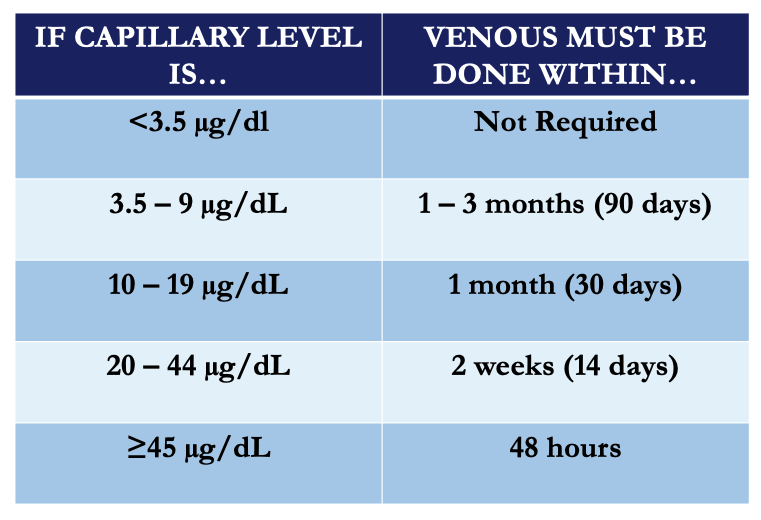

If a practice decides to use the LeadCare II Machine or any other point-of-care machine for lead testing, they must work with the Ohio Department of Health Clinical Lead Laboratory team to gain approval. Phone: (614) 466 – 1450 Email: lead@odh.ohio.gov
How to Overcome Resistance to Testing
If the caregiver says, “I don’t have time.”:
Explain that a blood lead test takes less than 5 minutes and will help connect their child to valuable resources to support and promote their growth and development.
If the caregiver says, “My child hasn’t been exposed to lead.”:
Share with them that lead is poisonous to the developing brain and can be found in older homes, toys, food, soil, water lines, and other places we might not suspect. A small, quick lead test will help keep their child safe.
If the caregiver says, “I wasn’t expecting this today.”:
Remind them that a blood lead test is based on state law and the circumstances of the patient. This test will take less than 5 minutes and may uncover an elevated blood lead level. Though the poke may not be comfortable, it is the only way to measure your child’s blood lead level.
If the caregiver says, “Do I have to do this now?”:
Inform them that it is easier to perform the blood lead test as they are in the office. Remind them that as their child moves around and becomes mobile, they may be putting things into their mouths, so it is better to assess risk early on.
If Your Patient Has an Elevated Blood Lead Level


After the blood lead test is completed and the lab analyzes the sample, the laboratory must report the results to the Ohio Department of Health.
The Ohio Department of Health inputs the results of the blood lead test into the Healthy Homes and Lead Poisoning Prevention Surveillance System. They determine which health department is responsible for case management. They input the results as “confirmed” (venous) or “unconfirmed” (capillary).
If the result is unconfirmed, a letter goes to the family informing them that they need to see their pediatrician for a venous blood draw to confirm the blood lead level.
- Confirmed results are further classified by blood lead level.
- Results <3.5µg/dL are imported, and no further action is done by ODH.
- Results 3.5 to less than 10µg/dL, ODH or delegated board of health conducts and interview with the parent or legal guardian. This includes education and a comprehensive questionnaire used to help identify source(s) of exposure.
- Results 10 µg/dL or higher, ODH or delegated board of health conducts a lead investigation. This includes an onsite lead inspection and risk assessment, as well as a comprehensive questionnaire.
*Review this list to determine if your health department acts as a delegated authority for the Ohio Department of Health. In this situation, the delegated authority assumes the responsibilities of the Ohio Department of Health and investigates the case of lead poisoning.

3.5 to less than 10µg/dL (Elevated Blood Lead Level Case)
- Send EBLL Parent/Guardian Initial Contact Letter. Simultaneously attempt to contact parent/guardian by phone/in person/text message/visiting the property with placement of contact information.
- Reach out to primary healthcare provider, Healthchek coordinator, local case manager, or other sources for alternate contact information.
- Send EBLL Parent/Guardian 2nd Contact Letter.
10 µg/dL or higher (Lead Poisoning Case)
- Attempt phone call to parent/guardian.
- Send Parent/Guardian Initial Contact Letter.
- Reach out to primary healthcare provider, Healthchek coordinator, local case manager, or other sources for alternate contact information.
- In-person visit, follow up phone call, or letter if alternate contact information obtained.
- Send Parent/Guardian Contact letter-2nd Notice by certified mail.
Acceptable Contact Attempts:
- Speaking with parent/guardian in-person or on the phone.
- Texting a valid number with delivery confirmation.
- Leaving a voicemail for the parent/guardian of the child or an adult associated with the child.
- Placing a door tag or other written notice on the entrance of the property address on the referral.
- Communication via mail to the parent/guardian.
- Communication via mail to the property owner after jurisdiction is established.
Contacting a disconnected or invalid phone number or outreach to an entity that may have valid contact information does not constitute a valid contact attempt.

The Ohio Healthy Homes Network (OHHN) is a nonprofit organization dedicated to promoting safe, healthy, and affordable housing for people of all ages. OHHN developed a list of lead prevention resources by county, which can be found here. If your patient and their family are experiencing legal or housing concerns as a result of their elevated blood lead level, contact your local Legal Aid Society or your medical/legal partnership. For remediation efforts, contact the Ohio Department of Health at 1-877-LEAD-SAFE or check out this list of remediation funding awardees.
If you are a homeowner who incurs qualifying lead abatement costs in your home, you may be eligible for a state tax credit. To learn more and to see if you are eligible click here.

Optimizing electronic medical records (EMR) helps you provide better care without sacrificing your time. Tips to improve your lead-related EMR:
- Use a health maintenance alert to remind you that a lead test is needed.
- Create an order set that comes up with the corresponding recommendation for care and treatment.
- Make a “Healthy Planet Dashboard” to give a real time pursuit list and metrics. This can create bulk reminders and trigger individual calls.
- Integrate Ohio AAP resources into your After Visit Summary. Scroll to our Resources to Use with Families module to find PDFs of these resources.
* Be sure to engage IT professionals from your organization.
Copy and paste the template below for your 6-, 12-, and 24-month well-child visit after visit summary!
Try making this a department-wide dot phrase and link or add a QR code to the Ohio AAP’s family resource page, found here.
Your child will be screened for lead poisoning at 12 and 24 months of age. The most common sources of lead exposure for children are chips of old lead-based paint and lead found in house dust and bare soil.
1. Carefully clean up any paint chips you find that have fallen on the floor, window ledges or the ground by wiping them up with damp paper towels.
2. Clean floors, windowsills, window ledges, porch railings and other surfaces by wet mopping or damp dusting. This should be done weekly until the home is safe.
3. Cover any bare soil that children might play in. Place mats outside all doors and have everyone wipe their feet before entering your home. Better still, have them remove their shoes.
4. Have your children wash their hands frequently; ALWAYS before eating and before bed. Wash their toys and pacifiers often (and anything else they may put in their mouths).
5. Provide your child with plenty of foods that naturally reduce the amount of lead that is absorbed by the body. These foods include CALCIUM (milk, cheese, cottage cheese, yogurt, tofu, dark-green leafy vegetables, canned salmon and sardines with bones and fortified cereals); IRON (lean red meats, liver, kidney, oyster, fish, greens like spinach, dried beans and peas, lentils, dried fruits raisins and apricots, prune juice, eggs, molasses, whole wheat bread and iron-fortified cereals) and VITAMIN C (oranges, strawberries, kiwi fruit, cantaloupe, honeydew, grapefruit, potatoes, tomatoes, broccoli, cauliflower, and cabbage).
6. If you have older plumbing, run the water for a few minutes before using it. Use only cold water for drinking and cooking.


For questions, comments, or concerns, please reach out to the Lead-Free Ohio program manager, Suhavi, at ssr@ohioaap.org.